Your P&L is a monthly average of a daily disaster
A blended margin tells you the business works. It cannot tell you which orders, products, discount codes and shipping methods are quietly undoing it.
Figures are illustrative, in GBP.
Herd Margin Guard works out true contribution margin on every Shopify order, after product cost, real shipping, payment fees and returns. Order by order, product by product, discount code by discount code.
Coming soon. The app is in final testing ahead of its Shopify App Store listing. Join the early-access list and take 30% off.
A blended margin tells you the business works. It cannot tell you which orders, products, discount codes and shipping methods are quietly undoing it.
Figures are illustrative, in GBP.
Discounts are read from the order's own discount allocations, so order-level discounts and code discounts are both counted — not just the line's discounted total. Getting this wrong is the most common way a margin app overstates revenue.
Taken from Shopify's own inventory unit cost, with an optional landed-cost uplift for duty and freight-in.
Mapped per shipping method: flat, weight-banded or per-item. Shown against what the customer actually paid, as over- or under-recovery. A mapped cost, not an estimate.
Mapped per gateway, with a Shopify Payments rate estimator.
Packaging per order and per item, 3PL per order and per item, and gift wrap.
Applied as a percentage on the orders where they apply.
A per-return-event cost and a per-item handling cost.
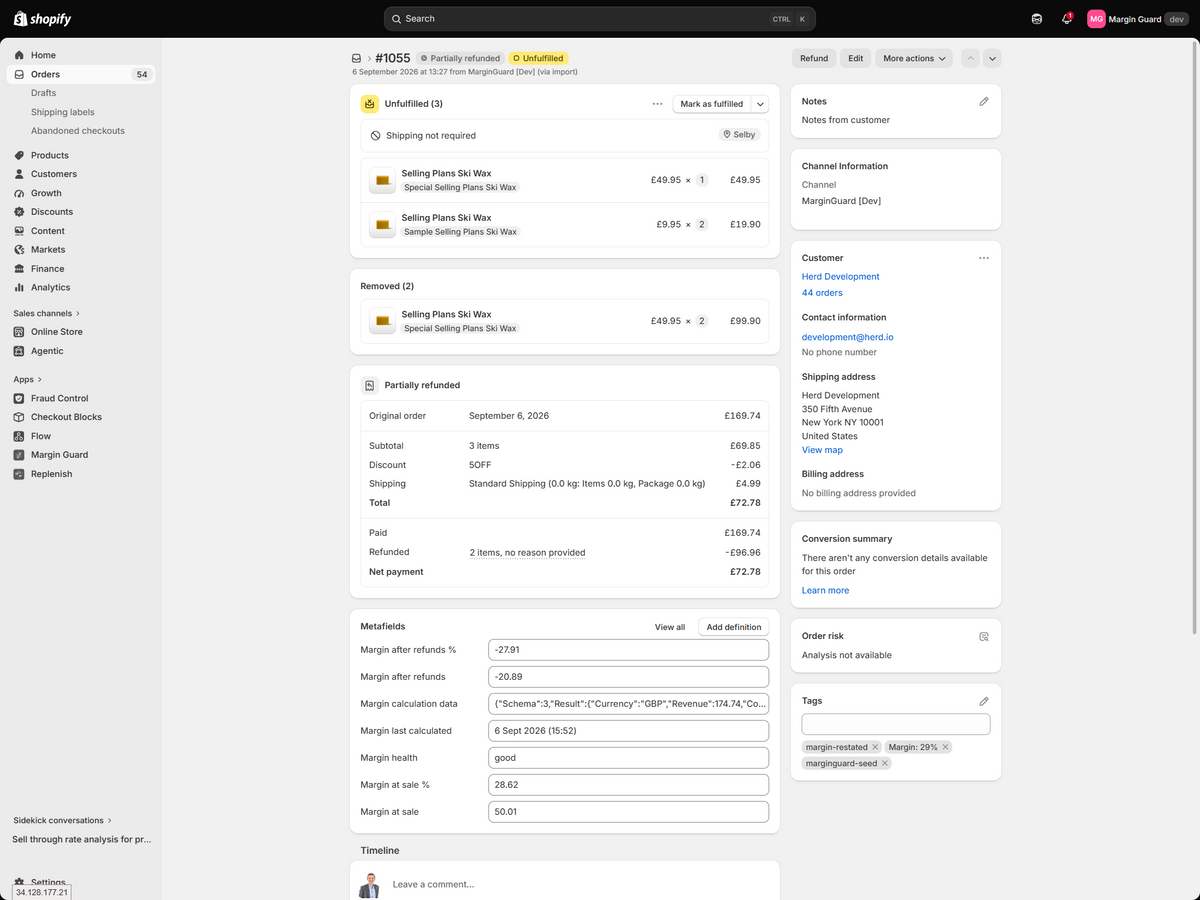
Margin at sale is the figure at the moment of sale. Margin after refunds restates it, because a refund takes the revenue back but leaves the shipping, the fee and the pick-pack already spent. The dashboard carries margin lost to refunds as its own figure. Most tools show only the first.
Order-level costs are split across lines by revenue share or by weight share, and the app tells you which basis it used. Weight share is the honest basis for shipping; revenue share is the honest basis for fees. An allocation is never presented as a measured cost.
Each report exists to drive one decision, not to be admired.
Margin Guard launches soon, get access to 30% off for the first 12 months by signing up today.

Margin Guard does not just report. It puts the figure where you already work.
Order metafields — margin at sale in £ and %, margin after refunds in £ and %, margin health, when it was last calculated and when refunds were last recalculated. Pinned, so they appear on the order page in your Shopify admin.
Order tags — margin-critical and margin-warning, so you can filter your native Shopify order list by margin health. There is also margin-not-applicable, because a gift-card sale is money held, not a sale.
A Shopify Flow trigger — fires when an order's margin is computed, so you can Slack a loss-making order, tag a customer or hold a fulfilment.
Get early accessA margin number is only as good as the cost data behind it, and mapping that data is real work. So the app tells you how much to trust it while you do.
A margin app that cannot tell you how much to trust it is asking you to take its word for it.
Billed monthly in USD. Every plan starts with a 14-day free trial. These are the standard rates — early sign-ups take 30% off.
Monthly billing only; there is no annual plan. Margin is computed in your shop's own currency. Higher volumes are handled case by case — ask us.
From Shopify's own inventory unit cost, with an optional landed-cost uplift for duty and freight-in. If a product has no unit cost the app flags it rather than guessing, and your data-quality score drops until you fill it in.
You map each shipping method once, as flat, weight-banded or per-item. The app compares that to what the customer actually paid and reports the difference as over- or under-recovery. Any method you have not mapped is shown as a setup gap.
No, and that is deliberate. We do not touch ad spend. Your fulfilment economics are hard enough to see, and that is the half your P&L hides. To model unit economics including media spend and target ROAS, use the free margin calculator instead.
You get both figures. Margin at sale is the number at the moment of sale. Margin after refunds restates it, because a refund returns the revenue but not the shipping, the payment fee or the pick-pack. The dashboard reports margin lost to refunds separately.
Order metafields and order tags, on orders. Nothing else. No products, prices, inventory or customers are touched.
Starter covers 60 days of order history; Grow and Plus cover your full history. During a free trial every plan shows 15 days, and your full history unlocks when the plan starts.
Margin is computed when the order is paid, on the Shopify orders/paid webhook. It is event-driven and fast, rather than a nightly batch.
The app is built and in final testing. The Shopify App Store listing has not been submitted yet. Join the early-access list and you will hear first, with 30% off.
Margin Guard is in final testing. Leave your details and we will tell you the moment it is live on the Shopify App Store. Early sign-ups take 30% off.